




















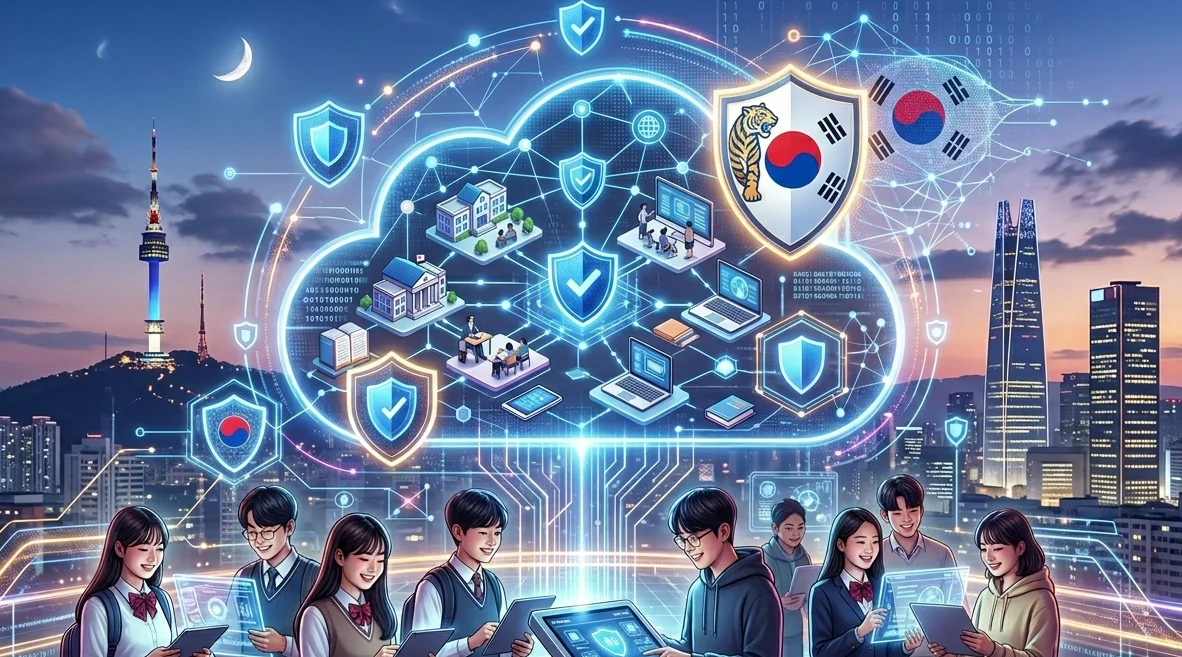
South Korea is stepping up its digital defenses for kids by expanding the reach of AI-powered cybersecurity systems, with a particular focus on private cloud environments used for teaching and learning. The Ministry of Education, working alongside the Korea Education and Research Information Service (KERIS), announced a series of upgrades designed to strengthen protection across a wide network of institutions.
At the center of this effort is artificial intelligence, which will detect and respond to cyber threats in real time.
Expanding AI-Powered Cybersecurity Across Education
The Ministry of Education currently operates the Education Cyber Security Center, with KERIS designated as the lead agency responsible for round-the-clock monitoring and incident response. This system oversees 435 institutions, including universities, public organizations, and regional education offices.
The backbone of this initiative is an internally developed AI-powered cybersecurity solution known as the “AI-based Automated Cyber Intrusion Detection and Notification System.” First introduced in 2022, the system uses artificial intelligence to identify suspicious activity and automate alerts. A notification feature added in 2024 further improved response times, creating a more comprehensive monitoring ecosystem.
The ministry reported that in 2025 alone, the system detected approximately 480 million potential cyber threat indicators across monitored institutions. Of these, about 86,000 cases were confirmed as actual intrusions and addressed. This marked a 36 percent increase compared to roughly 63,000 incidents recorded in 2024, before the latest system enhancements were implemented.
Launch of the AI Cyber Safety Center
A major milestone in this initiative is the official launch of the AI Cyber Safety Center on April 23, 2026. The new facility will act as a central hub for AI-powered cybersecurity, using artificial intelligence to collect, analyze, and respond to cyberattack data across the education sector.

In addition to strengthening existing defenses, the center will provide real-time monitoring for private cloud services. This is particularly significant as 158 out of the 435 monitored institutions have already adopted private cloud platforms for AI-driven educational tools and services.
Integrating Private Cloud Providers
To support this transition, the Ministry of Education began a pilot program in July 2025, connecting its detection infrastructure with three major private cloud providers: NAVER, NHN, and KT. The goal has been to ensure that detection rules and threat data can be securely transmitted between systems.
The ministry plans to expand this pilot to seven cloud providers by 2026, further broadening the scope of AI-powered cybersecurity coverage. This move reflects the growing importance of cloud-based infrastructure in modern education and the need for robust, AI-driven protection mechanisms.
Looking ahead, the ministry aims to refine its artificial intelligence systems to better suit the unique needs of educational institutions. By December 2026, the plan is to train the AI-powered cybersecurity model using log data collected from regional education offices. This includes information from security systems, networks, and servers.
The objective is to create a more specialized model capable of identifying threats specific to the education sector. Starting in 2027, this enhanced system will be deployed across regional education offices, enabling integrated monitoring and coordinated responses throughout the national education network.