





























New Zealand cyber incidents have reached their highest level in two years, and the money lost to them has more than doubled in just three months.
New Zealand’s National Cyber Security Centre (NCSC) received 1,694 incident reports between July and September 2026, according to its latest Cyber Security Insights report.
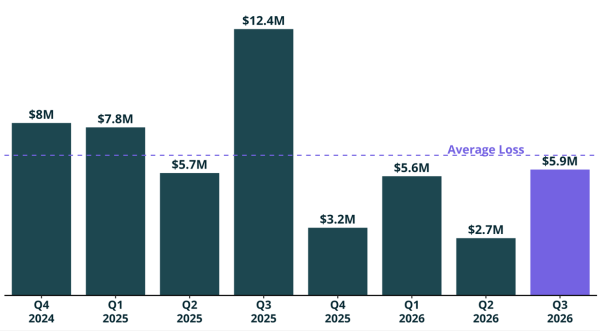
Reported financial losses climbed to $5.9 million, up 118% from $2.7 million in the previous quarter. The NCSC says it was its busiest quarter since Q3 2024.
How Much Did New Zealand Cyber Incidents Rise?
The jump was steep across every measure:
- 1,694 incident reports, up 50% from 1,129 in Q2 2026
- 179 incidents needed specialist technical support because of their potential national significance, up 94% from 92
- 1,515 reports did not need specialist support, up 46%
- 339 incidents involved a direct financial loss
The NCSC says reported incidents rose in every category.
Phishing Still Leads the List
Phishing and credential harvesting was again the most common type of incident, with 511 reports, a 56% increase on the previous quarter. Scams and fraud came second.

One category stood out for a different reason. Command and control server hosting returned for the first time since Q3 2025, with 94 incidents. These happen when attackers gain a foothold inside a network and connect it to their own infrastructure so they can send commands, install more malware or steal data.
Why Are New Zealand Cyber Incidents Increasing?
The NCSC points to frontier AI as a key factor.
The emergence of frontier AI systems is accelerating the cyber threat landscape,” said NCSC Deputy Director-General Catriona Robinson. Vulnerabilities can now be identified and exploited at unprecedented speed, enabling malicious actors to target New Zealanders and organisations at greater scale and volume than ever before.
The report notes that more vulnerabilities are being identified than ever before, and that they can be found and exploited faster and at greater scale.
Who Was Behind the Serious Attacks?
For the 179 incidents that needed specialist support, the NCSC tried to link the activity to known actors:
- 31% were likely linked to state-sponsored actors
- 26% were likely linked to cybercriminals
- 43% could not be linked to a known actor
How Serious Were the Incidents?
Most reports were minor, with 1,267 classed as C6. Higher up the scale, there were 73 routine C5 incidents, 53 moderate C4 incidents, 12 significant C3 incidents and one highly significant C2 incident. There were no C1 national cyber emergencies.
The education sector had one of the biggest jumps of the quarter. Reported incidents from education and training rose from 13 to 43, an increase of 230%.
What the NCSC Wants People to Do
Robinson said the rise should prompt action. Individuals, businesses, and organisations should take this as a signal to review their cyber security settings, ensure basic protections are in place, and remain vigilant against increasingly sophisticated online threats,” she said.
The report also includes two feature articles. The first looks at how quickly vulnerabilities are now being exploited, what organisations should do and how the NCSC issues critical vulnerability alerts.
The second examines how operational technology systems are increasingly being targeted by cybercriminals and how organisations can strengthen their defences.