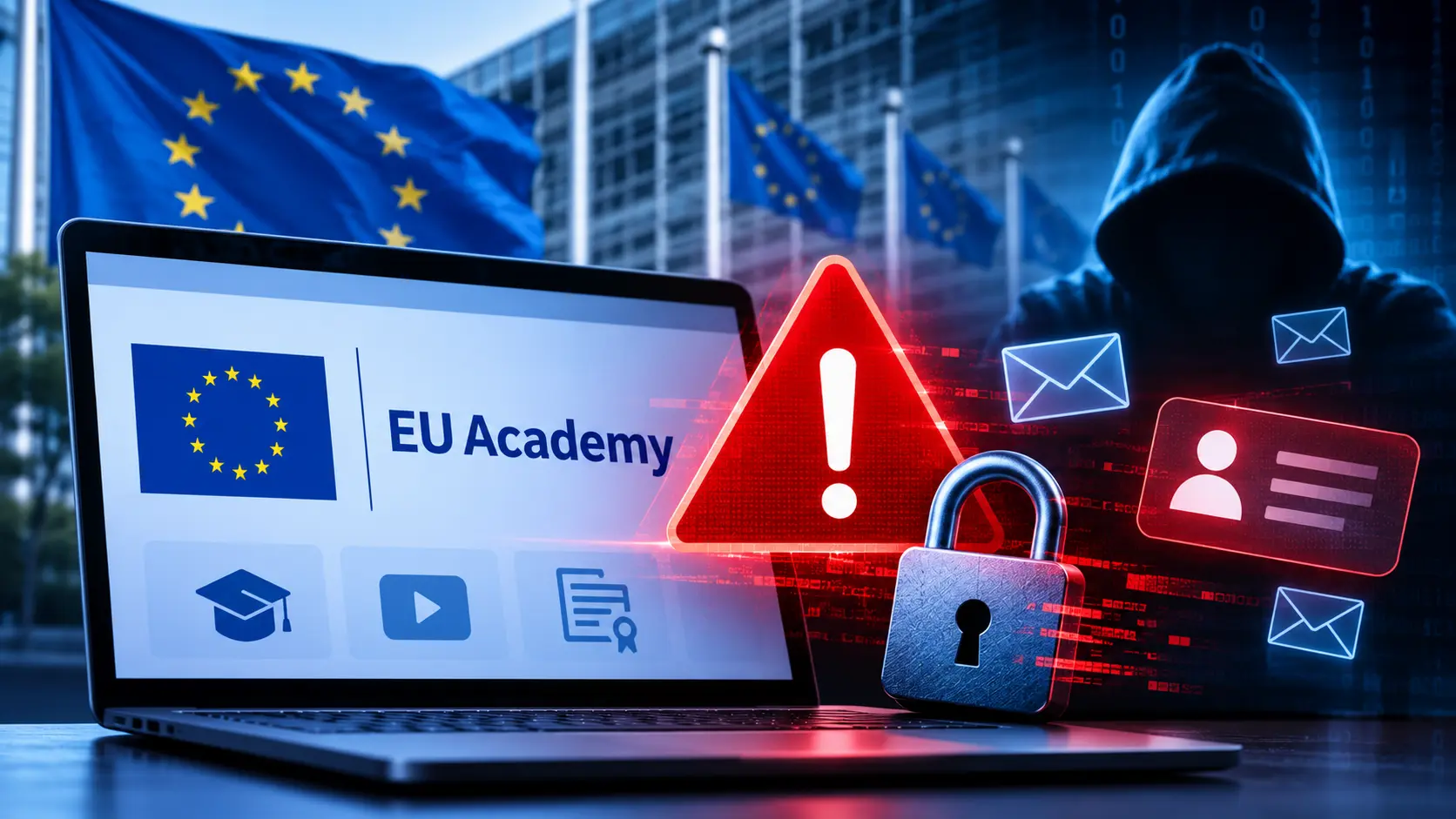



























EU Academy data breach warnings went out this week after the European Commission confirmed that names and email addresses were leaked from its online learning platform.
Public access to EU Academy has been shut off, the investigation is still running, and the full extent of the breach is not yet known.
The Commission has also warned staff to expect further temporary interruptions to internal systems.
What We Know About the EU Academy Data Breach
The Commission says it detected a cybersecurity incident on the EU Academy platform involving the personal data of its users. The data it has confirmed as leaked so far is names and email addresses.
In a notice to users, the Commission said public access to the platform has been disabled. It has also taken steps to contain the incident and limit its impact, including putting preventive, detective and corrective controls in place.
The Commission has not said how the breach happened, who was behind it, or how many users are affected.


Why Names and Emails Still Matter
A leak of names and email addresses can sound minor. The Commission’s own warning shows why it is not.
The notice lists the risks users now face: possible loss of user data, spearphishing attacks, identity misuse and impersonation, spam, and other attempts to gain access to their information.
With a real name and a confirmed email address, attackers can send messages that look like genuine EU Academy communications and are far more convincing than random spam.
What EU Academy Users Should Do
The Commission is asking users to take three steps:
- Stay especially alert to suspicious or unsolicited emails and messages.
- Avoid sharing personal information with new contacts who approach them about EU Academy or related activities.
- Report to a data protection authority if they believe their personal data has been used maliciously.
Why the EU Academy Data Breach Affects Learners Beyond Their Inbox
A separate notice on the EU Academy website says the platform is offline from 11 November 2026 to 14 January 2027 while a “faster, more secure, and more user-friendly” version is built. That notice does not mention the cybersecurity incident.
With the platform offline, users cannot log in, continue courses or download certificates. When it returns, they will need to create a new account. According to the notice, learning history will not transfer to the new platform, and not all content may be available right away when it reopens.
For regular users, that means more than a security warning. Anyone partway through a course, or who needs proof of past learning, will have to wait until mid-January and then start again on a new account.
What Remains Unclear
Several questions are still open:
- How the attackers got in. The Commission has not shared any technical details.
- How many users are affected. No figure has been given.
- What else was taken. Names and emails are confirmed, but the Commission says the incident is still under investigation and has warned of a possible loss of user data.
- The link to internal systems. Staff have been told to expect further temporary interruptions, but it is not clear how these relate to the incident.
Until the investigation concludes, the Commission’s advice is simple: treat any unexpected message mentioning EU Academy with caution.