

























A text message about an unpaid traffic challan could cost Android users in India far more than a fine. GhostBat RAT, an Android malware strain first identified by cybersecurity firm Cyble in October 2025, has evolved to capture PINs from 60 banking, UPI apps, wallet and fintech applications, according to new research published by Cyble.
The firm’s investigation into fake mParivahan and eChallan apps also exposed a wider operator-controlled ecosystem it tracks as GhostX, linking phishing pages, backend control systems and malware distribution.
How GhostBat RAT Reaches Victims
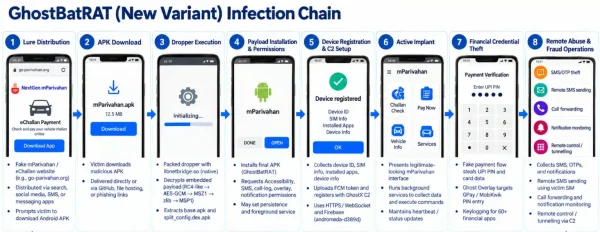
The malware spreads mainly through smishing, or SMS phishing. Victims receive messages with malicious links that lead to pages impersonating the official Parivahan service or a Google Play-style download page. These pages push users to install a fraudulent mParivahan APK. Researchers also found GitHub repositories being repeatedly used to host the malicious files.
Many of these apps are only first-stage loaders. The real payload stays hidden in encrypted files or is downloaded later, which makes the app look harmless during an initial scan.
GhostBat RAT’s Ghost Overlay Trick
The most significant change in the latest variant is its abuse of Android’s Accessibility Service, a technique commonly linked to modern Android banking trojan families. Earlier variants analyzed by Cyble did not have this capability.
Its standout feature, called Ghost Overlay, targets Google Pay and MobiKwik. Instead of showing a fake login screen, the malware places an invisible 12-key grid over the real PIN keypad. When a user taps a digit, the overlay records it and then replays the same tap into the genuine app. The payment goes through normally, so the victim has no visible reason to suspect anything, while the PIN is quietly sent to the attackers’ server.

GhostBat RAT Watches 60 Financial Apps
Beyond Google Pay and MobiKwik, a broader keylogging feature monitors 60 financial apps. Cyble’s list includes PhonePe, Paytm, BHIM, SBI UPI, Axis Pay, BharatPe, CRED, Freecharge, PayZapp, Groww, Navi, Jupiter, OneCard, JioFinance and Samsung Pay. The malware checks which app is open and the screen context before treating numeric input as a possible PIN.
This builds on older capabilities that remain in play, including reading SMS messages and OTPs, manipulating call forwarding, collecting call logs and sending SMS messages through the victim’s SIM card, which could be used to spread further smishing campaigns.
Inside the GhostX Network Behind GhostBat RAT
A key finding came from an exposed Firebase backend named “ghostx-panel.” It contained administrator records, user roles, login logs with device fingerprints and bot-user mappings. Cyble says these separate roles point to a multi-operator setup and raise the possibility of a Malware-as-a-Service model.
While monitoring the backend, researchers saw SMS lure text, phishing links, vehicle registration numbers and recipient phone numbers changing repeatedly, indicating an active campaign. Matching eChallan messages were also reported by users on social media.
Why GhostBat RAT Is Hard to Detect
Cyble identified at least six different loader designs. The newest, built around a native library called libnetbridge.so, passes the payload through several layers of encryption, compression and custom packaging before the final app appears. Security tools that scan only the outer APK are unlikely to catch it consistently.
The malware also uses Firebase Remote Config, which lets operators switch command servers and turn features on or off remotely without pushing a new app to victims.
Staying Safe From GhostBat RAT
Cyble advises users to install apps only from official stores such as Google Play and to avoid APK links received by SMS, social media or email. Users should be cautious about granting app permissions, especially Accessibility access, verify website addresses before entering sensitive details, enable multi-factor authentication on financial apps and keep their phones updated. Anyone who suspects infection should contact their bank and local authorities immediately.