


















Singapore has launched its largest-ever coordinated cyber defense operation following a highly targeted cyberattack on telecommunications that affected all four of the country’s major telecommunications operators.
The cyberattack in Singapore was attributed to the advanced threat actor UNC3886, according to Minister for Digital Development and Information and Minister-in-charge of Cybersecurity and Smart Nation Group, Josephine Teo. She disclosed the details on Feb. 9 while speaking at an engagement event for cyber defenders involved in the national response effort, codenamed Operation Cyber Guardian.
Teo confirmed that the UNC3886 cyberattack in Singapore targeted M1, Singtel, StarHub, and Simba.
Also read: ‘UNC3886 is Attacking Our Critical Infrastructure Right Now’: Singapore’s National Security Lawmaker

Decoding the UNC3886 Cyberattack in Singapore
Once suspicious activity was detected, the affected operators immediately alerted the Infocomm Media Development Authority (IMDA) and the Cyber Security Agency of Singapore (CSA). CSA, IMDA, and several other government bodies then launched Operation Cyber Guardian to contain the breach.
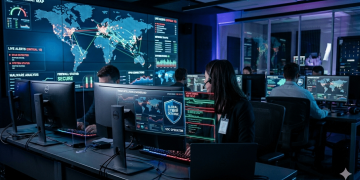
The operation involved more than 100 cyber defenders from six government agencies, including CSA, IMDA, the Singapore Armed Forces’ Digital and Intelligence Service, the Centre for Strategic Infocomm Technologies, the Internal Security Department, and GovTech, all working closely with the telcos.
Teo said the response has, for now, managed to limit the attackers’ activities. Although the attackers accessed a small number of critical systems in one instance, they were unable to disrupt services or move deeper into the telco networks. “There is also no evidence thus far to suggest that the attackers were able to access or steal sensitive customer data,” she said.

UNC3886 Cyberattack Posed Severe Risks to Essential Services
Despite the containment, Teo warned against complacency. She stressed that the cyberattack in Singapore highlighted the presence of persistent threat actors capable of targeting critical infrastructure. She added that sectors such as power, water, and transport could also face similar threats and urged private-sector operators to remain vigilant.
The government, Teo said, will continue to work closely with critical infrastructure operators through cybersecurity exercises and the sharing of classified threat intelligence to enable early detection and faster response. “But even as we try our best to prevent and detect cyber-attacks, we may not always be able to stop them in time,” she said. “All of us must also be prepared for the threat of disruption.”
The UNC3886 operation was first revealed publicly in July 2025 by Minister for Home Affairs and Coordinating Minister for National Security K Shanmugam. Teo described the telecommunication cyberattack as a “potentially more serious threat” than previous cyber incidents faced by Singapore, noting that it targeted systems directly responsible for delivering essential public services.
“The consequences could have been more severe,” she said. “If the attack went far enough, it could have allowed the attacker to one day cut off telecoms or internet services.”
Investigations later revealed that the UNC3886 cyberattack in Singapore was a deliberate, targeted, and well-planned campaign aimed specifically at the telco sector. The attackers exploited a zero-day vulnerability, a previously unknown flaw for which no patch was available at the time. Teo likened this to “finding a new key that no one else had found, to unlock the doors to our telcos’ information system and networks.”
After gaining access, UNC3886 reportedly stole a small amount of technical data and used advanced techniques to evade detection and erase forensic traces. Beyond espionage, the group was assessed to have the capability to disrupt telecommunications and internet services, which could have had knock-on effects on banking, finance, transport, and medical services.
Telcos and Government Strengthen Defenses Against Persistent Threats
In a joint statement, M1, Singtel, StarHub, and Simba said they face a wide range of cyber threats, including distributed denial-of-service attacks, malware, phishing, and persistent campaigns.
To counter these risks, the telcos said they have implemented defense-in-depth measures and carried out prompt remediation when vulnerabilities are identified. They also emphasized close collaboration with government agencies and industry experts to strengthen resilience. “Protecting our critical infrastructure is a top priority. We will continue to keep pace with the evolving cyber threat landscape and update our measures accordingly,” the statement said.
UNC3886 is a China-linked cyber espionage actor classified as an Advanced Persistent Threat. The “UNC” label indicates that the group remains uncategorized. Cybersecurity researchers have observed that UNC3886 frequently targets network devices and virtualization technologies, often exploiting zero-day vulnerabilities. The group primarily focuses on defense, technology, and telecommunication organizations in the United States and Asia.