














• About Us
  • Contact Us
  • Editorial Calendar
  • Careers
  • The Cyber Express by Cyble Vulnerability Disclosure Policy
  • Cyble Trust Portal
The Cyber Express
  • MagazineDownload
  • Firewall Daily
    • All
    • Bug Bounty & Rewards
    • Dark Web News
    • Data Breach News
    • Hacker News
    • Ransomware News
    • Vulnerabilities
    weekly roundup September 18 2026

    The Cyber Express Weekly Roundup: Hiscox’s SMB Warning, a Nintendo Switch Flaw, and a Record Deepfake Takedown

    Contagious Interview, WaterPlum, North Korea

    Four Countries Attribute “Contagious Interview” Fake-Job Malware Campaign to North Korea’s WaterPlum

    CVE-2026-76460

    Cisco ISE Vulnerability With CVSS 10.0 Score Under Active Attack

    Thinkng Bull Cyberattack

    South Korea Math Academy Hit by Cyberattack, Student Data at Risk

    Iranian cyber actors

    Fake Apps, Real Spies: How Iran Tracks Dissidents Through Telegram

    EU KIDS Act

    Children Under 13 Could Be Barred From Social Media Under New EU Plan

    threat intelligence

    Cyble, UAE Cyber Security Council Unite Against Rising Cyber Threats

    CVE-2026-90894

    New Parallels Desktop Flaw Lets Local Users Seize Root Control of Macs

    GUARD Act

    US House Passes Bill to Help Police Track Down Scammers Targeting Seniors

    Trending Tags

    • blackbyte ransomware
    • Ransomware
    • lapsus$ ransomware
    • Apple
    • Apple vulnerability
  • Essentials
    • All
    • Compliance
    • Governance
    • Policy Updates
    • Regulations
    EU KIDS Act

    Children Under 13 Could Be Barred From Social Media Under New EU Plan

    GUARD Act

    US House Passes Bill to Help Police Track Down Scammers Targeting Seniors

    Emergency Security Protocol

    EU Plans ‘Article 4’-Style Security Protocol for Cyberattacks and Hybrid Threats

    Cyber Resilience Act, CRA, EU, EU Sanctions, Iran, Chinese Hacking,

    EU’s 24-Hr Vulnerability Reporting Rules Take Effect Friday, a Year Before the Rest of the Cyber Resilience Act

    outage communications

    CISA, FBI Urge Clearer Communication During Major Outages

    A session cookie depicted as a key being stolen from a browser window while a two-factor authentication prompt sits bypassed, illustrating Claude session hijacking by infostealer malware.

    Anthropic Warns Commodity Infostealers Are Hijacking Claude Sessions to Drain Paid Usage

    Social Media Ban

    New Zealand Moves to Ban Social Media for Under-16s

    Prompt Injection, Grok, Grok AI, Gemini, Fraud, Agentic AI, AI-assisted Cyberattacks

    Encrypted Prompts Defeat Grok and Gemini Guardrails; Chat Histories Stolen

    India online safety rules

    India Tightens Social Media Rules to Protect Children Online

    • Regulations
    • Compliance
    • Governance
    • Policy Updates
  • Knowledge Hub
    • All
    • How to
    • What is
    Google Chrome

    How to Remove Saved Passwords From Google Chrome (And Why You Should)

    DPDP Rules, Cyble, DPDP Act, Cyble Vantage

    How Cyble’s Front-Row Vantage Can Help You in Complying to India’s DPDP Act

    Cybersecurity Countries

    The Top 8 Countries Leading the Cyber Defense Race in 2025

    link building

    The Link Building Secrets Your Competitors Don’t Want You to Know

    Supply Chain Attack

    Supply Chain Resilience and Physical Security: Lessons for 2025

    Healthcare cybersecurity trends of 2024

    Healthcare Cybersecurity: 2024 Was Tough, 2025 May Be Better

    CEO's Guide to Take-Down Services

    Shield Your Organization: CEO’s Perspective on Take-Down Services

    Azure sign-in Microsoft

    Microsoft Announces Mandatory MFA for Azure Sign-ins to Bolster Cloud Defenses

    Signal Proxy, Signal, Signal Ban in Russia, Signal Ban in Venezuela, Bypass Signal Ban, How to Activate Signal Proxy, Signal Proxy Server

    How to Set Up Signal Proxy to Help Bypass Censorship in Russia and Venezuela

  • Features
    • Cyber Warfare
    • Espionage
    • Workforce
      • Learning & Development
  • Business
    • All
    • Appointments
    • Budgets
    • Mergers & Aquisitions
    • Partnerships
    • Press Release
    • Startups
    weekly roundup September 18 2026

    The Cyber Express Weekly Roundup: Hiscox’s SMB Warning, a Nintendo Switch Flaw, and a Record Deepfake Takedown

    threat intelligence

    Cyble, UAE Cyber Security Council Unite Against Rising Cyber Threats

    Ukraine cybersecurity

    Zelensky Appoints Ihor Klymenko to Lead Ukraine’s Cybersecurity Center

    UK cyberattack rate

    UK Small Firms Bear Brunt of Rising Cyberattacks, Hiscox Finds

    Cyber Yodha Campaign

    Cyble and DRONA Launch New Push to Close India’s Cybersecurity Gap

    UK Ukraine AI partnership

    Britain Gains Access to Ukraine’s ‘Goldmine’ of Battlefield AI Data

    Hims & Hers lawsuit

    FTC Sues Hims & Hers Over Health Data Privacy, Billing Practices

    Australia-India PACTS

    Australia-India PACTS to Deepen Cybersecurity and Tech Collaboration

    Sunil Varkey

    Sunil Varkey Joins Hexaware Technologies as EVP & CISO

    • Startups
    • Mergers & Aquisitions
    • Partnerships
    • Appointments
    • Budgets
    • Research
      • Whitepapers
      • Sponsored Content
      • Market Reports
    • Interviews
      • Podcast
  • Events
    • Conference
    • Webinar
    • Endorsed Events
  • Advisory Board
No Result
View All Result
  • MagazineDownload
  • Firewall Daily
    • All
    • Bug Bounty & Rewards
    • Dark Web News
    • Data Breach News
    • Hacker News
    • Ransomware News
    • Vulnerabilities
    weekly roundup September 18 2026

    The Cyber Express Weekly Roundup: Hiscox’s SMB Warning, a Nintendo Switch Flaw, and a Record Deepfake Takedown

    Contagious Interview, WaterPlum, North Korea

    Four Countries Attribute “Contagious Interview” Fake-Job Malware Campaign to North Korea’s WaterPlum

    CVE-2026-76460

    Cisco ISE Vulnerability With CVSS 10.0 Score Under Active Attack

    Thinkng Bull Cyberattack

    South Korea Math Academy Hit by Cyberattack, Student Data at Risk

    Iranian cyber actors

    Fake Apps, Real Spies: How Iran Tracks Dissidents Through Telegram

    EU KIDS Act

    Children Under 13 Could Be Barred From Social Media Under New EU Plan

    threat intelligence

    Cyble, UAE Cyber Security Council Unite Against Rising Cyber Threats

    CVE-2026-90894

    New Parallels Desktop Flaw Lets Local Users Seize Root Control of Macs

    GUARD Act

    US House Passes Bill to Help Police Track Down Scammers Targeting Seniors

    Trending Tags

    • blackbyte ransomware
    • Ransomware
    • lapsus$ ransomware
    • Apple
    • Apple vulnerability
  • Essentials
    • All
    • Compliance
    • Governance
    • Policy Updates
    • Regulations
    EU KIDS Act

    Children Under 13 Could Be Barred From Social Media Under New EU Plan

    GUARD Act

    US House Passes Bill to Help Police Track Down Scammers Targeting Seniors

    Emergency Security Protocol

    EU Plans ‘Article 4’-Style Security Protocol for Cyberattacks and Hybrid Threats

    Cyber Resilience Act, CRA, EU, EU Sanctions, Iran, Chinese Hacking,

    EU’s 24-Hr Vulnerability Reporting Rules Take Effect Friday, a Year Before the Rest of the Cyber Resilience Act

    outage communications

    CISA, FBI Urge Clearer Communication During Major Outages

    A session cookie depicted as a key being stolen from a browser window while a two-factor authentication prompt sits bypassed, illustrating Claude session hijacking by infostealer malware.

    Anthropic Warns Commodity Infostealers Are Hijacking Claude Sessions to Drain Paid Usage

    Social Media Ban

    New Zealand Moves to Ban Social Media for Under-16s

    Prompt Injection, Grok, Grok AI, Gemini, Fraud, Agentic AI, AI-assisted Cyberattacks

    Encrypted Prompts Defeat Grok and Gemini Guardrails; Chat Histories Stolen

    India online safety rules

    India Tightens Social Media Rules to Protect Children Online

    • Regulations
    • Compliance
    • Governance
    • Policy Updates
  • Knowledge Hub
    • All
    • How to
    • What is
    Google Chrome

    How to Remove Saved Passwords From Google Chrome (And Why You Should)

    DPDP Rules, Cyble, DPDP Act, Cyble Vantage

    How Cyble’s Front-Row Vantage Can Help You in Complying to India’s DPDP Act

    Cybersecurity Countries

    The Top 8 Countries Leading the Cyber Defense Race in 2025

    link building

    The Link Building Secrets Your Competitors Don’t Want You to Know

    Supply Chain Attack

    Supply Chain Resilience and Physical Security: Lessons for 2025

    Healthcare cybersecurity trends of 2024

    Healthcare Cybersecurity: 2024 Was Tough, 2025 May Be Better

    CEO's Guide to Take-Down Services

    Shield Your Organization: CEO’s Perspective on Take-Down Services

    Azure sign-in Microsoft

    Microsoft Announces Mandatory MFA for Azure Sign-ins to Bolster Cloud Defenses

    Signal Proxy, Signal, Signal Ban in Russia, Signal Ban in Venezuela, Bypass Signal Ban, How to Activate Signal Proxy, Signal Proxy Server

    How to Set Up Signal Proxy to Help Bypass Censorship in Russia and Venezuela

  • Features
    • Cyber Warfare
    • Espionage
    • Workforce
      • Learning & Development
  • Business
    • All
    • Appointments
    • Budgets
    • Mergers & Aquisitions
    • Partnerships
    • Press Release
    • Startups
    weekly roundup September 18 2026

    The Cyber Express Weekly Roundup: Hiscox’s SMB Warning, a Nintendo Switch Flaw, and a Record Deepfake Takedown

    threat intelligence

    Cyble, UAE Cyber Security Council Unite Against Rising Cyber Threats

    Ukraine cybersecurity

    Zelensky Appoints Ihor Klymenko to Lead Ukraine’s Cybersecurity Center

    UK cyberattack rate

    UK Small Firms Bear Brunt of Rising Cyberattacks, Hiscox Finds

    Cyber Yodha Campaign

    Cyble and DRONA Launch New Push to Close India’s Cybersecurity Gap

    UK Ukraine AI partnership

    Britain Gains Access to Ukraine’s ‘Goldmine’ of Battlefield AI Data

    Hims & Hers lawsuit

    FTC Sues Hims & Hers Over Health Data Privacy, Billing Practices

    Australia-India PACTS

    Australia-India PACTS to Deepen Cybersecurity and Tech Collaboration

    Sunil Varkey

    Sunil Varkey Joins Hexaware Technologies as EVP & CISO

    • Startups
    • Mergers & Aquisitions
    • Partnerships
    • Appointments
    • Budgets
    • Research
      • Whitepapers
      • Sponsored Content
      • Market Reports
    • Interviews
      • Podcast
  • Events
    • Conference
    • Webinar
    • Endorsed Events
  • Advisory Board
No Result
View All Result
The Cyber Express
No Result
View All Result
Home Features Espionage

Google Dismantles Massive Proxy Network That Hid Espionage, Cybercrime for Nation-State Actors

Legal action against IPIDEA reduces available proxy devices by millions, disrupting infrastructure that masked malicious activity for threat groups from China, Russia, Iran and North Korea.

Mihir Bagwe by Mihir Bagwe
January 29, 2026
in Espionage, Cyber Essentials, Cyber News, Firewall Daily
0
Proxy Network, Google, Google Threat Intelligence, Nation-State Actors,
647
SHARES
3.6k
VIEWS
Share on LinkedInShare on Twitter

Google dismantled what is believed to be one of the world’s largest residential proxy networks, taking legal action to seize domains controlling IPIDEA’s infrastructure and removing millions of consumer devices unknowingly enrolled as proxy exit nodes.

The takedown involved platform providers, law enforcement and security firms working to eliminate a service that enabled espionage, cybercrime and information operations at scale.

Residential proxy networks sell access to IP addresses owned by internet service providers and assigned to residential customers. By routing traffic through consumer devices worldwide, attackers mask malicious activity behind legitimate-looking IP addresses, creating significant detection challenges for network defenders.

IPIDEA became notorious for facilitating multiple botnets, with its software development kits playing key roles in device enrollment while proxy software enabled attacker control. This includes the BadBox2.0 botnet Google targeted with legal action last year, plus the more recent Aisuru and Kimwolf botnets.

Also read: Cloudflare Outage or Cyberattack? The Real Reason Behind the Massive Disruption

The scale of abuse proves staggering. During just one week in January this year, Google observed over 550 individual threat groups it tracks using IP addresses associated with IPIDEA exit nodes to obfuscate their activities. These groups originated from China, North Korea, Iran and Russia, conducting activities including access to victim software-as-a-service environments, on-premises infrastructure compromise and password spray attacks.

“While proxy providers may claim ignorance or close these security gaps when notified, enforcement and verification is challenging given intentionally murky ownership structures, reseller agreements, and diversity of applications,” Google’s analysis stated.

Google’s investigation revealed that many ostensibly independent residential proxy brands actually connect to the same actors controlling IPIDEA. The company identified 13 proxy and VPN brands as part of the IPIDEA network, including 360 Proxy, ABC Proxy, Cherry Proxy, Door VPN, IP 2 World, Luna Proxy, PIA S5 Proxy and others.

The same actors control multiple software development kit domains marketed to app developers as monetization tools. These SDKs support Android, Windows, iOS and WebOS platforms, with developers paid per download for embedding the code. Once incorporated into applications, the SDKs transform devices into proxy network exit nodes while providing whatever primary functionality the app advertised.

Google analyzed over 600 Android applications across multiple download sources containing code connecting to IPIDEA command-and-control domains. These apps appeared largely benign—utilities, games and content—but utilized monetization SDKs enabling proxy behavior without clear disclosure to users.

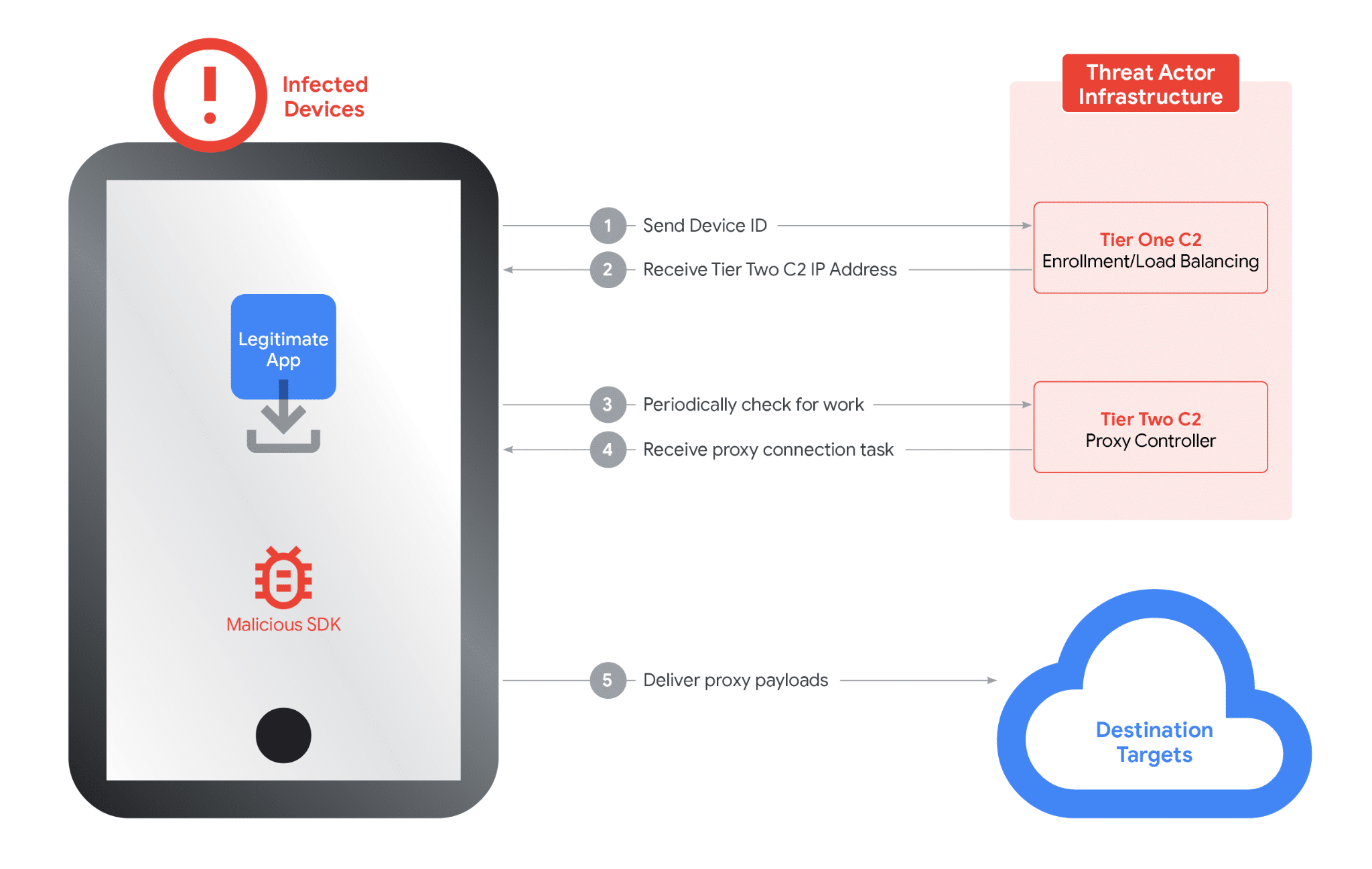
The technical infrastructure operates through a two-tier system. Upon startup, infected devices connect to Tier One domains and send diagnostic information. They receive back a list of Tier Two servers to contact for proxy tasks. The device then polls these Tier Two servers periodically, receiving instructions to proxy traffic to specific domains and establishing dedicated connections to route that traffic.
Proxy Network, Google, Google Threat Intelligence, Nation-State Actors,
Two-Tier C2 Infrastructure. (Source: Google Threat Intelligence)

Google identified approximately 7,400 Tier Two servers as of the takedown. The number changes daily, consistent with demand-based scaling. These servers are hosted globally, including in the United States.

Analysis of Windows binaries revealed 3,075 unique file hashes where dynamic analysis recorded DNS requests to at least one Tier One domain. Some posed as legitimate software like OneDriveSync and Windows Update, though IPIDEA actors didn’t directly distribute these trojanized applications.

Residential proxies pose direct risks to consumers whose devices become exit nodes. Users knowingly or unknowingly provide their IP addresses and devices as launchpads for hacking and unauthorized activities, potentially causing providers to flag or block them. Proxy applications also introduce security vulnerabilities to home networks.

When a device becomes an exit node, network traffic the user doesn’t control passes through it. This means attackers can access other devices on the same private network, effectively exposing security vulnerabilities to the internet. Google’s analysis confirmed IPIDEA proxy software not only routed traffic through exit nodes but also sent traffic to devices to compromise them.

Google’s disruption involved three coordinated actions. First, the company took legal action to seize domains controlling devices and proxying traffic through them. Second, Google shared technical intelligence on discovered IPIDEA software development kits with platform providers, law enforcement and research firms to drive ecosystem-wide enforcement.

Third, Google ensured Play Protect, Android’s built-in security system, automatically warns users and removes applications incorporating IPIDEA SDKs while blocking future installation attempts. This protects users on certified Android devices with Google Play services.

Google believes the actions significantly degraded IPIDEA’s proxy network and business operations, reducing available devices by millions. Because proxy operators share device pools through reseller agreements, the disruption likely impacts affiliated entities downstream.

Also read: What Is a Proxy Server? A Complete Guide to Types, Uses, and Benefits

The residential proxy market has become what Google describes as a “gray market” thriving on deception—hijacking consumer bandwidth to provide cover for global espionage and cybercrime. Consumers should exercise extreme caution with applications offering payment for “unused bandwidth” or “internet sharing,” as these represent primary growth vectors for illicit proxy networks.

Google urges users to purchase connected devices only from reputable manufacturers and verify certification. The company’s Android TV website provides up-to-date partner lists, while users can check Play Protect certification status through device settings.

The company calls for proxy accountability and policy reform. While some providers may behave ethically and enroll devices only with clear consumer consent, any claims of “ethical sourcing” must be backed by transparent, auditable proof. App developers bear responsibility for vetting monetization SDKs they integrate.

Share this:

  • Share on LinkedIn (Opens in new window) LinkedIn
  • Share on Reddit (Opens in new window) Reddit
  • Share on X (Opens in new window) X
  • Share on Facebook (Opens in new window) Facebook
  • More
  • Email a link to a friend (Opens in new window) Email
  • Share on WhatsApp (Opens in new window) WhatsApp

Related

Tags: GoogleGoogle Threat IntelligenceNation-State ActorsProxy Network
Previous Post

Acting CISA Chief Flagged for Uploading Sensitive Government Files Into ChatGPT

Next Post

Bumble, Panera Bread, Match Group, and CrunchBase Hit by New Wave of Cyberattacks

Next Post
Bumble

Bumble, Panera Bread, Match Group, and CrunchBase Hit by New Wave of Cyberattacks

Q1 2026 Threat Reports

❮ ❯
Cyble-Vision


Follow Us On Google News

Latest Cyber News

weekly roundup September 18 2026
Firewall Daily

The Cyber Express Weekly Roundup: Hiscox’s SMB Warning, a Nintendo Switch Flaw, and a Record Deepfake Takedown

September 18, 2026
Contagious Interview, WaterPlum, North Korea
Cyber News

Four Countries Attribute “Contagious Interview” Fake-Job Malware Campaign to North Korea’s WaterPlum

September 18, 2026
CVE-2026-76460
Firewall Daily

Cisco ISE Vulnerability With CVSS 10.0 Score Under Active Attack

September 18, 2026
Thinkng Bull Cyberattack
Firewall Daily

South Korea Math Academy Hit by Cyberattack, Student Data at Risk

September 18, 2026

Categories

Web Stories

Do This on Telegram, Your Bank Account Will Become Zero
If You Install the iOS 18 Beta, Your iPhone Could Be Hacked
Cricket World Cup Ticketing Systems Under Cybersecurity
Cyber Threats and Online Ticket Scams During the NBA Finals
Biometric Data Security: Protecting Sensitive Information

About

The Cyber Express

#1 Trending Cybersecurity News and Magazine

The Cyber Express is a handbook for all stakeholders of the internet that provides information security professionals with the latest news, updates and knowledge they need to combat cyber threats.


Contact

For editorial queries: [email protected]

For marketing and Sales: [email protected]


Quick Links

  • About Us
  • Contact Us
  • Editorial Calendar
  • Careers
  • The Cyber Express by Cyble Vulnerability Disclosure Policy
  • Cyble Trust Portal

Our Address

We’re remote friendly, with office locations around the world:

San Francisco, Atlanta, Rome,
Dubai, Mumbai, Bangalore, Hyderabad,  Singapore, Jakarta, Sydney, and Melbourne


Headquarters:

The Cyber Express LLC
10080 North Wolfe Road, Suite SW3-200, Cupertino, CA, US 95014


India Office:

Cyber Express Media Network
HD-021, 4th Floor, C Wing, Building No.4. Nesco IT Park, WE Highway, Goregaon East, Mumbai, Maharashtra, India – 4000063

  • Privacy Statement
  • Terms of Use
  • Write For Us

© 2026 The Cyber Express - Cybersecurity News and Magazine.

Welcome Back!

Login to your account below

Forgotten Password?

Retrieve your password

Please enter your username or email address to reset your password.

Log In

Add New Playlist

No Result
View All Result
  • Magazine
  • Firewall Daily
  • Essentials
    • Regulations
    • Compliance
    • Governance
    • Policy Updates
  • Knowledge Hub
  • Features
    • Cyber Warfare
    • Espionage
    • Workforce
      • Learning & Development
  • Business
    • Startups
    • Mergers & Aquisitions
    • Partnerships
    • Appointments
    • Budgets
    • Research
      • Whitepapers
      • Sponsored Content
      • Market Reports
    • Interviews
      • Podcast
  • Events
    • Conference
    • Webinar
    • Endorsed Events
  • Advisory Board

© 2026 The Cyber Express - Cybersecurity News and Magazine.

Are you sure want to unlock this post?
Unlock left : 0
Are you sure want to cancel subscription?
-
00:00
00:00

Queue

Update Required Flash plugin
-
00:00
00:00
Do This on Telegram, Your Bank Account Will Become Zero If You Install the iOS 18 Beta, Your iPhone Could Be Hacked Cricket World Cup Ticketing Systems Under Cybersecurity Cyber Threats and Online Ticket Scams During the NBA Finals Biometric Data Security: Protecting Sensitive Information