


















The European Commission has adopted the EU KIDS Act, a proposal that would introduce new age restrictions and safety requirements for online platforms used by children across the European Union. The proposal would prevent social media platforms from allowing children under 13 to access their services and establish an EU-wide minimum age of 15 for minors to open accounts independently.
The EU KIDS Act would also shift the burden of proof to online service providers, requiring them to demonstrate that their services are safe by design and appropriate for younger users.
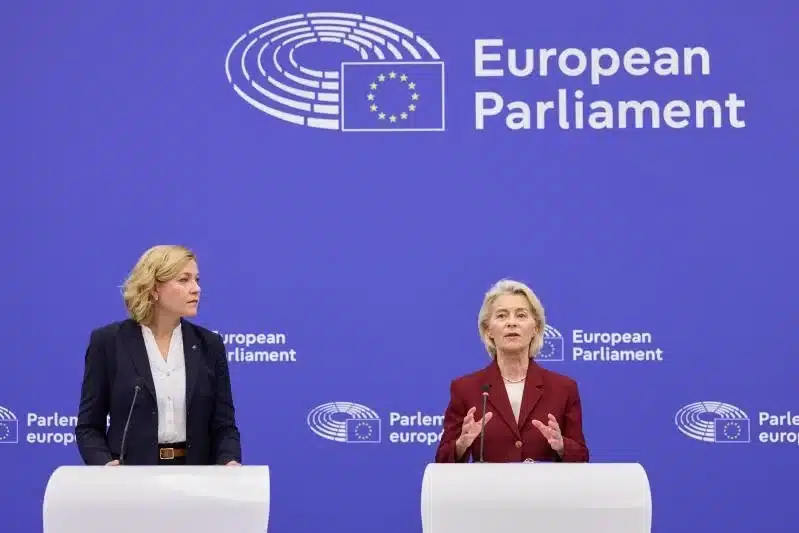
Commission President Ursula von der Leyen said the proposal is intended to give parents greater control over how children use digital services.
“Today, our children are engaging with the most sophisticated technologies ever created. Technology that was never created with their wellbeing in mind. Our KIDS Act is reversing the burden of proof – it is for platforms to show they are safe by design. And we put parents back in the driving seat, giving them the tools to help their children navigate a safer online world,” von der Leyen said.
EU KIDS Act Sets New Social Media Age Limits
Under the EU KIDS Act, children between 13 and under 15 would not be able to create autonomous social media accounts. Instead, they could use mini accounts managed through a parent or guardian’s account, with access limited to age-appropriate social media and video-sharing services.
These mini accounts would include safeguards such as restricted social contacts and screen time of up to one hour per day.

Children between 3 and under 13 would not be permitted to access social media. They could, however, use specially designed child-friendly video-sharing services through guardian-managed accounts. Parents would also receive tools to restrict an adult device to those services when it is given to a child, with exposure limited to a maximum of one hour per day.
Safety-by-Design Rules Target Addictive Features
The proposal would introduce safety-by-design obligations for online services offering social media, video sharing, online video games, AI companions and chatbots to users under 18.
The proposed rules would prohibit addictive features and profiling-based recommendation feeds that can draw minors toward harmful content. Infinite scrolling without stopping points, reward mechanisms and push notifications during sleeping hours would also be restricted.
The proposal would further prohibit unsolicited contact from strangers. AI companions and chatbots would have to be turned off by default and could not simulate interpersonal relationships in ways that create emotional dependency.
Minor profiles would be private by default, while geolocation, camera and microphone access would be turned off. Platforms would also need to provide tools allowing minors to block or mute users, manage their time and control, tune and reset recommender systems.
Privacy-Preserving Age Assurance Proposed
The EU KIDS Act would require online services and app stores to use age assurance tools. The proposal points to the EU age verification app as one possible approach, with the system designed not to retain identity documents or biometric data.
Social media and video-sharing platforms would be expected to perform age verification when users create new accounts. For existing accounts, providers would estimate a user’s age using reasonable indicators, such as the account creation date or credit card details.
EU Plans Faster Enforcement
The proposal would require very large online platforms to prove that their services are safe by design. Providers would submit compliance plans to the European Commission and an independent auditor, which would assess new services, features or functionalities.
If the Commission identifies shortcomings based on an auditor’s report, it could require providers to propose corrective measures. The enforcement framework would build on existing structures under the Digital Services Act and Artificial Intelligence Act.
For noncompliance, the proposal includes expedited enforcement procedures under which the Commission should conclude investigations within 90 days.
Henna Virkkunen, Executive Vice-President for Tech Sovereignty, Security and Democracy, said the proposal would allow children to use digital services while increasing safeguards and accountability for platforms.
“With our EU KIDS Act, we make sure our children can enjoy their rights online – to learn, stay connected and explore. We also give parents the tools to accompany their kids to navigate a safe digital world. All of this by keeping the pressure high on platforms, because they must prove their services do not harm,” Virkkunen said.
EU KIDS Act Moves to Parliament and Council
The legislative proposal has now been submitted to the European Parliament and the Council for examination and adoption.
The proposal follows recommendations from the European Commission’s Special Panel on Child Safety Online, which included more than 60 experts from areas including civil society, education, public health, child psychiatry and technology.
The Commission said public support for stronger online protections is also growing. According to the 2026 Special Eurobarometer on the Digital Decade, 92% of Europeans consider strengthening protection for children and young people online a top policy priority.