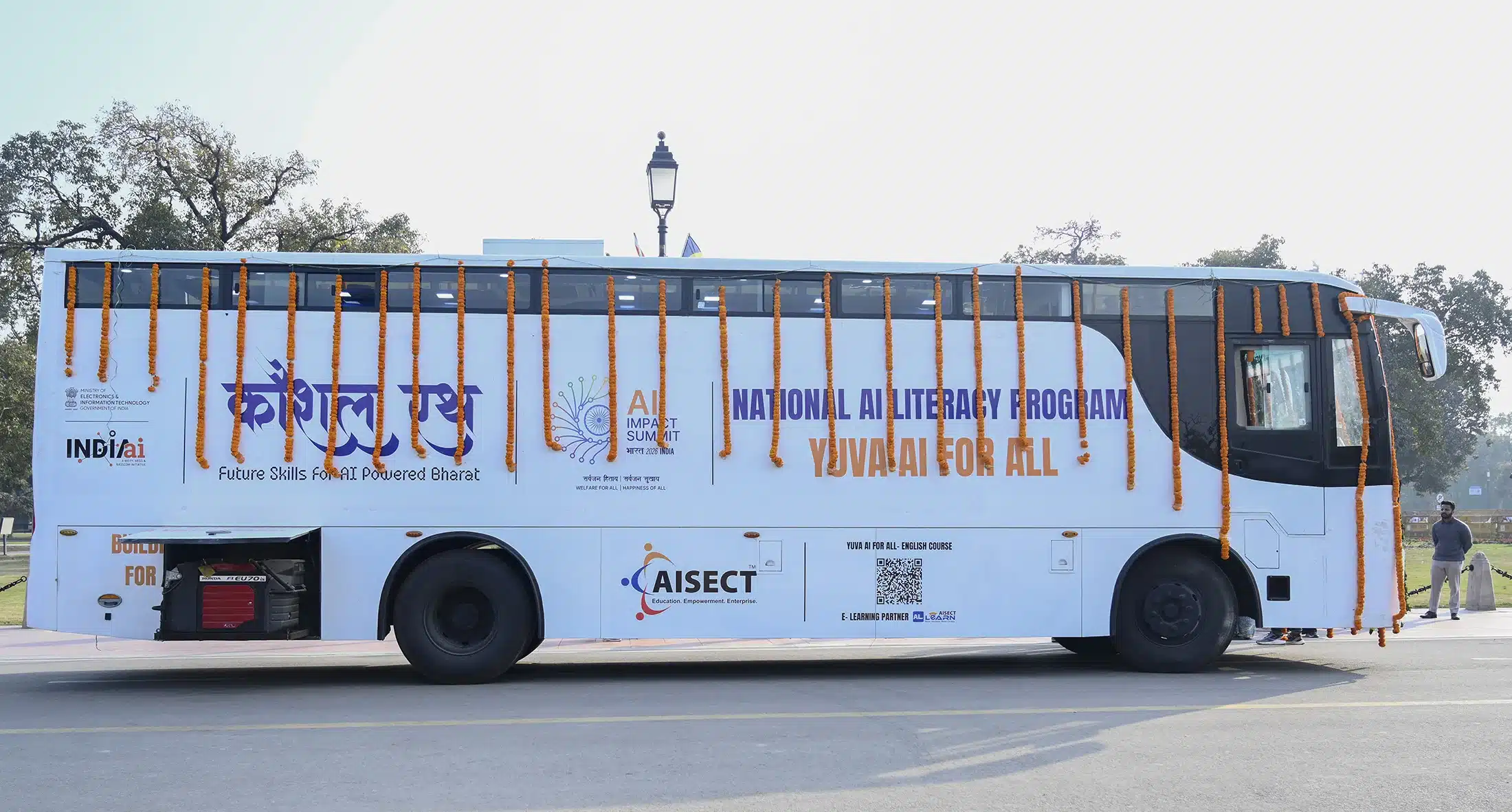































India has taken another step toward expanding AI literacy in India with the launch of Kaushal Rath under the national programme Yuva AI for All. Flagged off from India Gate in New Delhi, the mobile initiative aims to bring foundational Artificial Intelligence (AI) education directly to students, youth, and educators, particularly in semi-urban and underserved regions.
For a country positioning itself as a global digital leader, the message behind Yuva AI for All is clear: AI cannot remain limited to elite institutions or metro cities.
If Artificial Intelligence is to shape economies and governance, it must be understood by the wider population.
Yuva AI for All: Taking AI to the Doorstep
Launched by the Ministry of Electronics and Information Technology (MeitY) under the IndiaAI Mission in collaboration with AISECT, Yuva AI for All focuses on democratising access to AI education.
Launching the initiative, the Minister of State Jitin Prasada stated, “Through the Yuva AI for All initiative and the Kaushal Rath, we are taking AI awareness directly across the country, especially to young people. The bus will travel across regions to familiarise students and youth with the uses and benefits of Artificial Intelligence, fulfilling the Prime Minister Narendra Modi’s vision of ensuring that awareness and access to opportunity transcend geography and demography.”
Adding to this, he also said that “The Yuva AI for All with Kaushal Rath initiative is a precursor to the India AI Impact Summit 2026, which is set to take place in New Delhi next week. It is a great pride for India to be hosting a Summit of this kind for the first time, to be held in the Global South. “

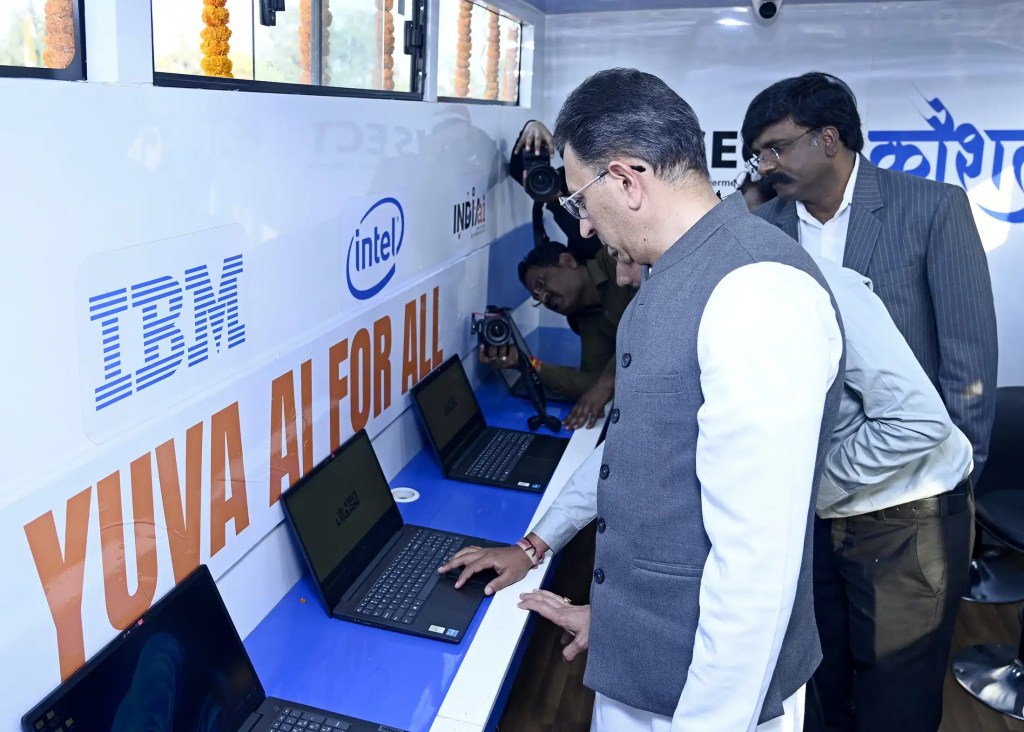
At the centre of this effort is Kaushal Rath, a fully equipped mobile computer lab with internet-enabled systems and audio-visual tools. The vehicle will travel across Delhi-NCR and later other regions, visiting schools, ITIs, colleges, and community spaces. The aim is not abstract policy messaging, but practical exposure—hands-on demonstrations of AI and Generative AI tools, guided by trained facilitators and contextualised Indian use cases.
The course structure is intentionally accessible. It is a four-hour, self-paced programme with six modules, requiring zero coding background. Participants learn AI concepts, ethics, and real-world applications. Upon completion, they receive certification, a move designed to add tangible value to academic and professional profiles.
Kavita Bhatia, Scientist G, MeitY and COO of IndiaAI Mission highlighted, “Under the IndiaAI Mission, skilling is one of the seven core pillars, and this initiative advances our goal of democratising AI education at scale. Through Kaushal Rath, we are enabling hands-on AI learning for students across institutions using connected systems, AI tools, and structured courses, including the YuvAI for All programme designed to demystify AI. By combining instructor-led training, micro- and nano-credentials, and nationwide outreach, we are ensuring that AI skilling becomes accessible to learners across regions.”
In a global context, this matters. Many nations speak of AI readiness, but few actively drive AI education beyond established technology hubs. Yuva AI for All attempts to bridge that gap.
Building Momentum Toward the India AI Impact Summit 2026
The launch of Yuva AI for All and Kaushal Rath also builds momentum toward the upcoming India AI Impact Summit 2026, scheduled from February 16–20 at Bharat Mandapam, New Delhi.
Positioned as the first global AI summit to be hosted in the Global South, the event is anchored on three pillars: People, Planet, and Progress. The summit aims to translate global AI discussions into development-focused outcomes aligned with India’s national priorities.
But what distinguishes this effort is its nationwide groundwork. Over the past months, seven Regional AI Conferences were conducted across Meghalaya, Gujarat, Odisha, Madhya Pradesh, Uttar Pradesh, Rajasthan, and Kerala under the IndiaAI Mission.
These conferences focused on practical AI deployment in governance, healthcare, agriculture, education, language technologies, and public service delivery. Policymakers, startups, academia, industry leaders, and civil society participated, ensuring that discussions were not limited to theory.
Insights from these regional consultations will directly shape the agenda of the India AI Impact Summit 2026.
A Nationwide AI Push, Not Just a Summit
Several major announcements emerged from the regional conferences. Among them:
- A commitment to train one million youth under Yuva AI for All
- Expansion of AI Data Labs and AI Labs in ITIs and polytechnics
- Launch of Rajasthan’s AI/ML Policy 2026
- Announcement of the Uttar Pradesh AI Mission
- Introduction of Madhya Pradesh’s SpaceTech Policy 2026 integrating AI
- Signing of MoUs with institutions including Google, IIT Delhi, and National Law University, Jodhpur
- Rollout of AI Stacks and cloud adoption frameworks for state-level governance
These developments suggest that India’s AI roadmap is not confined to policy speeches. It is being operationalised across states, with funding commitments and institutional backing.
For global observers, this signals something important. Emerging economies are not merely consumers of AI technologies—they are actively shaping governance models and skilling frameworks suited to their socio-economic realities.
Why AI Literacy in India Matters Globally
Artificial Intelligence is often discussed in terms of advanced research and frontier innovation. Yet the real challenge is adoption—ensuring people understand what AI is, what it can do, and how it should be used responsibly.
By launching Yuva AI for All, India is placing emphasis on foundational awareness, not just high-end research. That approach reflects a broader recognition: AI will influence public service delivery, agriculture systems, healthcare models, and digital governance worldwide. Without widespread literacy, the risk of exclusion grows.
At the same time, scaling AI education in a country as large and diverse as India is no small task. The success of Kaushal Rath will depend on sustained outreach, quality training, and long-term institutional support.
Still, the initiative marks a visible shift. AI is no longer framed as a specialist subject—it is being positioned as a public capability.
As preparations intensify for the India AI Impact Summit 2026, Yuva AI for All stands out as a reminder that AI’s future will not be shaped only in boardrooms or research labs, but also in classrooms, ITIs, and community spaces across regions often left out of the digital conversation.