





























The India AI Impact Summit 2026 commenced on February 16 at Bharat Mandapam, New Delhi, India, marking the first time that a global convening of this scale on artificial intelligence (AI) in the Global South. Over five days, from 16–20 February 2026, the Summit is bringing together Heads of State and Government, ministers, global technology leaders, eminent researchers, multilateral institutions and industry stakeholders to deliberate on how AI can advance inclusive growth, strengthen public systems and enable sustainable development.
With participation from over 100 government representatives, including more than 20 Heads of State and Government and 60 Ministers and Vice Ministers, alongside 500+ global AI leaders, CEOs, founders, academicians, CTOs and philanthropic organisations, the India AI Impact Summit 2026 is not just another tech conference.
It is a geopolitical signal that the Global South intends to shape the AI narrative, not simply respond to it.
India AI Impact Summit 2026 and the Future of Employability
A defining theme at the India AI Impact Summit 2026 has been employability in the age of automation. In a high-level discussion on “The Future of Employability in the Age of AI,” India’s Chief Economic Advisor, Dr. V. Anantha Nageswaran, called for a national commitment to align AI adoption with mass employability.
His message was clear — AI’s impact will not be accidental. With foresight and institutional discipline, India could demonstrate how a large society harnesses AI to create human abundance rather than dislocation. Without deliberate alignment, however, AI could intensify inequality.
Industry leaders echoed this concern. Automation is increasingly replacing sub-skills built during the industrial era. What remains valuable are macro skills, systemic thinking, imagination, adaptability and lifelong learning. The consensus at the India AI Impact Summit 2026 was pragmatic: uncertainty around job displacement exists, but adaptability is the only viable strategy.

Importantly, discussions did not frame AI solely as a threat. In healthcare, for instance, experts argued that AI could expand community-based delivery models and generate new roles. The challenge is preparing the workforce for transition, not resisting technological evolution.
AI for India, AI for the World
On Day 1 of the India AI Impact Summit 2026, India’s Minister of State for Electronics and IT Jitin Prasada articulated India’s global ambition: AI not only for India, but for the whole world. This vision positions India as a service provider and partner to the developing world and the Global South.
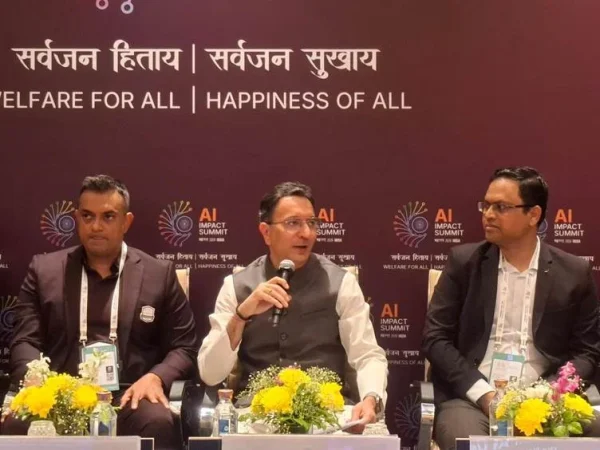
The Summit’s debates on digital sovereignty reflected that ambition. Policymakers emphasised hardware-rooted sovereignty, trusted infrastructure, and affordable access to AI compute. Rather than subsidising infrastructure indiscriminately, India has underwritten access — enabling researchers, startups and small enterprises to leverage AI resources at significantly lower cost.
Sessions on “Operationalising Open Source AI” reinforced that sovereignty extends beyond owning models. It includes governance frameworks, compute infrastructure, auditability mechanisms and resilience across the AI stack. For many developing nations, this approach offers a template for balancing openness with national control.
From Policy to Implementation: Global Impact Challenges
A major highlight of the India AI Impact Summit 2026 is the culmination of three flagship Global Impact Challenges — AI for ALL, AI by HER and YUVAi. Together, these challenges attracted over 4,650 applications from more than 60 countries, underscoring strong international participation and reinforcing India’s emergence as a credible hub for responsible and scalable AI innovation.
Following a rigorous multi-stage evaluation process led by domain experts and policymakers, the top 70 teams have been selected as finalists. They are presenting their solutions during the Grand Finale and Awards Felicitation Ceremony at Bharat Mandapam and Sushma Swaraj Bhawan in New Delhi.
The design of these challenges is notable. They are not symbolic showcases but structured pipelines linking innovation to ecosystem support. Finalists engage directly with policymakers, investors and academia, increasing the likelihood that promising AI solutions scale beyond prototypes.
The India AI Impact Summit 2026 also hosted the India AI Impact Buildathon, which engaged tens of thousands of learners nationwide. Participants completed foundational AI courses before competing with solutions addressing digital and financial fraud. This mass participation model reflects a deeper structural shift — democratising AI readiness rather than restricting it to elite institutions.
Anchored in People, Planet and Progress
The India AI Impact Summit 2026 is structured around three core pillars: People, Planet and Progress. Seven thematic working groups are driving outcome-oriented recommendations across AI for Economic Growth and Social Good; Democratisation of AI Resources; Inclusion for Social Empowerment; Safe and Trusted AI; Human Capital; Science; and Resilience, Innovation and Efficiency.
This architecture matters. Too often, AI forums remain at the level of principles. Here, working groups are tasked with linking policy dialogue to implementation pathways. The Summit will conclude with deliberations focused on scaling AI for inclusive economic growth, strengthening international partnerships and advancing responsible innovation frameworks for the Global South.
By connecting innovation with public purpose, the India AI Impact Summit 2026 signals a transition from dialogue to delivery. It aligns technological advancement with sustainable development objectives and positions India as both convenor and collaborator in global AI governance.
A Global South Assertion
For international observers, the most significant takeaway from the India AI Impact Summit 2026 is not any single announcement. It is the broader assertion that the Global South can convene, contribute and co-create AI standards rather than passively import them.
India’s model, blending employability, sovereignty, inclusion and infrastructure — is ambitious. Whether it can execute at scale remains to be seen. But by anchoring AI discussions in human capital and development priorities, the Summit offers an alternative narrative to purely market-driven AI expansion.
In that sense, the India AI Impact Summit 2026 may well be remembered not just as a conference, but as a defining moment in how emerging economies seek to shape the future of artificial intelligence.